Commercial Food Truck Insurance: Coverage Checklist
Quick answer
A food truck usually needs commercial auto plus liability coverage, with property/equipment and workers' compensation added according to the rig, staffing, contracts, and state rules. Confirm requirements with the relevant agencies, lender, commissary, venues, and a licensed insurance professional before binding coverage.
Commercial food truck insurance is not a single universal policy. Operators usually combine commercial auto, general or product liability, equipment/property coverage, and—when applicable—workers’ compensation. This checklist explains what each coverage does, which requirements can come from law or contracts, and what to confirm before buying. For premiums and monthly budgeting, use the separate food truck insurance cost guide.
What Insurance Does a Food Truck Need?
A food truck is several businesses rolled into one vehicle, so it usually needs a stack of coverages rather than a single policy. Most operators carry a combination of the following, often bundled into a Business Owner’s Policy (BOP) or a specialized food-truck program:
- General liability — third-party bodily injury and property damage
- Commercial auto — the truck itself, on the road
- Product liability — illness or injury caused by your food
- Property / equipment / inventory — your gear and stock
- Workers’ compensation — required once you have employees
- Business interruption — lost income when you can’t operate
Some of these are legally mandated; others are strongly recommended or required by the venues, commissaries, and events you work with. The mix you actually need depends on your state, your staffing, and where you park and serve.
Coverage Types and Typical Annual Costs
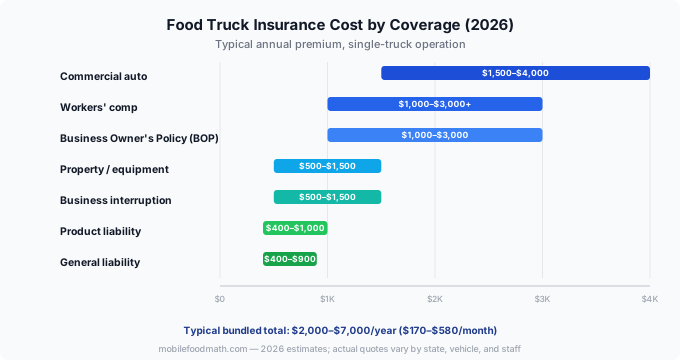
The table below summarizes the core coverages, what each protects against, and a rough annual premium range for a single-truck operation in 2026. Bundling several of these into one program is usually cheaper than buying them separately.
| Coverage | What It Covers | Typical Annual Cost |
|---|---|---|
| General Liability | Customer slip-and-fall, property damage you cause to others | $400 – $900 |
| Commercial Auto | Collision, liability, and damage involving the truck on the road | $1,500 – $4,000 |
| Product Liability | Foodborne illness, allergic reaction, contamination claims | $400 – $1,000 |
| Property / Equipment | Cooking equipment, generators, POS, inventory loss or theft | $500 – $1,500 |
| Workers’ Compensation | Employee injury, medical costs, lost wages | $1,000 – $3,000+ |
| Business Interruption | Lost income during covered shutdowns | $500 – $1,500 |
| Business Owner’s Policy (BOP) | Bundled GL + property (sometimes more) | $1,000 – $3,000 |
Treat these figures only as budgeting context; premiums depend on the carrier, location, limits, deductibles, vehicle, staff, menu, and claims history. The food truck insurance cost guide has the annual and monthly comparisons. Specialty operators should make sure refrigeration, espresso equipment, generators, and other high-value mobile equipment are specifically included where needed.
General Liability Insurance
General liability (GL) is the foundation of any food truck policy. It pays for third-party bodily injury and property damage — a customer who trips on a cord and breaks a wrist, or hot oil that damages a vendor’s tent next to you. Most events, farmers markets, and private bookings will not let you serve without proof of GL, typically requiring a $1 million per-occurrence / $2 million aggregate limit. Expect to pay roughly $400 to $900 per year for standalone GL, though it’s frequently bundled into a BOP at a better combined rate.
Commercial Auto Insurance
Commercial auto is usually the single most expensive line on a food truck policy, and a personal auto policy will not cover a vehicle used for business. It handles liability if you cause an accident, collision and comprehensive damage to your own truck, and often the built-in cooking equipment while the vehicle is in transit. Annual premiums commonly run $1,500 to $4,000, driven heavily by the truck’s value, your driving record, and how many miles you put on it. A high-value custom build can push well past $4,000.
Product Liability Insurance
Because you’re serving food, product liability is critical — it covers claims that your product made someone sick or caused an allergic reaction. A single foodborne-illness lawsuit can be devastating without it. Sometimes product liability is folded into your general liability policy; other times it’s a separate line. Standalone coverage typically adds $400 to $1,000 per year. Given how exposed a food business is here, this is one coverage almost no operator should skip.
Property, Equipment, and Inventory Coverage
Your griddle, fryer, refrigeration, generator, POS system, and food inventory all represent real money — often tens of thousands of dollars. Commercial property (sometimes called inland marine or equipment coverage for mobile gear) reimburses you for theft, fire, vandalism, or breakdown of this equipment. Expect roughly $500 to $1,500 per year depending on the replacement value you’re insuring. Document your equipment with receipts and photos so claims go smoothly.
Workers’ Compensation Insurance
Once you hire employees, workers’ compensation is legally required in nearly every state (Texas is the notable exception, and some states exempt very small employers). It pays medical bills and a portion of lost wages when a worker is injured on the job — burns and cuts being common in a tight, hot truck. Cost is driven by your payroll and class codes, generally landing $1,000 to $3,000+ per year for a small crew. Misclassifying workers or skipping coverage can trigger steep fines, so confirm your state’s threshold before your first hire.
Business Interruption Insurance
Business interruption (sometimes called business income) replaces lost revenue when a covered event — say a fire or major equipment failure — forces you to stop operating while you repair or rebuild. For a seasonal or event-driven business, even a few weeks offline can be financially serious. It usually adds $500 to $1,500 per year and is often available as an add-on to a BOP. Note that most policies exclude routine slow seasons and many pandemic-style shutdowns, so read the triggers carefully.
What’s Legally Required vs. Recommended
It helps to separate what the law forces you to carry from what’s merely smart business — though in practice, the “recommended” items are often required by the venues you work with.
| Coverage | Status | Notes |
|---|---|---|
| Commercial Auto | Required | Mandatory in all states for a business vehicle |
| Workers’ Compensation | Required (with employees) | Mandatory in nearly all states once you hire |
| General Liability | Recommended / Often required | Demanded by most events, markets, and landlords |
| Product Liability | Strongly recommended | Critical for any food business; sometimes required |
| Property / Equipment | Recommended | Often required if your truck is financed |
| Business Interruption | Optional | Valuable for seasonal or single-location operators |
If your truck is financed or leased, the lender will almost certainly require physical-damage (collision/comprehensive) coverage as a condition of the loan, regardless of what your state mandates.
Budget After You Choose the Coverage
Price comparisons only make sense when every quote uses the same vehicles, drivers, limits, deductibles, endorsements, and covered equipment. Build that coverage specification first, then compare premiums and payment schedules in the food truck insurance cost guide. Model the resulting recurring expense in the profit calculator.
Additional Insured and Event Requirements
When you book events, festivals, commissary kitchens, or private venues, the host will frequently ask to be listed as an additional insured on your general liability policy. This extends your coverage to protect them if something goes wrong at their site, and it’s standard practice — most carriers add an additional insured for free or a small fee. You’ll typically provide a certificate of insurance (COI) showing your limits, often $1M/$2M, sometimes with a specific waiver of subrogation.
Build a little lead time into your event calendar: requesting and receiving a COI naming a specific venue can take a day or two, and showing up without the right paperwork can mean being turned away at the gate. Keep a digital copy of your current COI handy and confirm each host’s exact requirements well before the event date.
Commercial Food Truck Insurance by State
State law determines which coverages are legally mandatory and heavily influences pricing. Here’s how the major food-truck markets compare:
| State | Commercial Auto Required | Workers’ Comp Threshold | GL Required by Law | Notes |
|---|---|---|---|---|
| California | Yes | 1+ employee | No (but required by venues) | High-cost state; fire risk surcharge common |
| Texas | Yes | No mandate (opt-in) | No | Most affordable market; workers’ comp optional |
| New York | Yes | 1+ employee | No | NYC surcharges push premiums 20–40% above state average |
| Florida | Yes | 4+ employees (construction: 1+) | No | State DBPR license required before permit |
| Illinois | Yes | 1+ employee | No | Chicago proximity-to-restaurant rules affect coverage terms |
| Colorado | Yes | 1+ employee | No | Moderate costs; Denver event vendors often need event-specific riders |
| Oregon | Yes | 1+ employee | No | Cart-pod operators sometimes covered under pod owner’s umbrella |
| Washington | Yes | 1+ employee | No | L&I (state fund) covers workers’ comp; private carriers not available |
The most important state-specific check: in Washington, workers’ compensation is administered exclusively through the state L&I fund — you cannot buy it from a private insurer. In Texas, workers’ comp is optional but lenders and commissaries may still require it.
How to Get Food Truck Insurance Quotes
Gathering quotes takes roughly 30–60 minutes and can save hundreds of dollars annually. Here’s how to do it efficiently:
What you’ll need before calling brokers
- Your truck’s year, make, model, and VIN
- Estimated annual mileage and operating radius
- Menu type (determines fire/liability risk tier)
- Number of employees and approximate annual payroll
- List of events or venues you plan to work (some require additional insured certificates)
- Your driving history (past 3–5 years)
- Whether the truck is financed (lender requirements)
Where to get quotes
- Specialist brokers (Markel, FLIP, Next Insurance, Hiscox) price specifically for mobile food — often 15–25% below general commercial brokers
- State farm bureaus and local independent agents can bundle with your personal auto and home for multi-policy discounts
- Your commissary’s recommended carrier — some commissaries negotiate group rates for their members
Questions to ask every carrier
- Does the GL policy include product liability, or is it a separate line?
- Is the cooking equipment covered in transit under commercial auto or property?
- What’s the claims process if I have a health department shutdown?
- Do you offer blanket additional-insured coverage or must I list each venue separately?
- What triggers business interruption — does it cover health code violations?
Getting three or more quotes before binding is standard practice and almost always surfaces meaningful price differences for identical coverage.
Claims Scenarios and How Insurance Responds
Understanding when your policy actually pays out helps you avoid coverage gaps:
A customer slips on a wet spot near your truck. → General liability pays. Your GL covers third-party bodily injury. With $1M per-occurrence limits, a broken wrist lawsuit typically settles well within coverage.
Your generator fails at a weekend festival and you lose a full refrigeration load of product. → Property/equipment coverage pays for the lost inventory, subject to your deductible. Business interruption may also cover lost revenue from that weekend if the failure is covered under the policy’s trigger.
A customer reports a foodborne illness and files a claim. → Product liability responds. If product liability is bundled into your GL, it’s the same policy. If separate, the product liability policy pays. Legal defense costs are usually covered even if the claim is disputed.
You rear-end another vehicle while driving to an event. → Commercial auto pays the other party’s damages and your truck’s repairs (if you carry collision). A personal auto policy would not cover this.
An employee cuts their hand badly on kitchen equipment. → Workers’ compensation pays medical bills and a portion of lost wages. Without it, you’re personally liable in most states and face potential fines.
Your truck is totaled in a fire while parked at the commissary. → Commercial auto (comprehensive) covers the vehicle; property coverage handles the equipment and inventory inside it. If you’re financing the truck, the lender is typically the first payee.
Frequently Asked Questions
Does my food truck need insurance before I can get a permit? Requirements vary. Some permitting authorities require specific insurance evidence, while others separate insurance from the health-permit process. Events, commissaries, property owners, and lenders can impose their own requirements. Confirm each one before applying or signing a contract.
What insurance is legally required for a food truck? Commercial auto and workers’ compensation requirements depend on the vehicle, state, business structure, and staffing. General or product liability may also be required by a permit, venue, commissary, landlord, lender, or client even when it is not a statewide statutory requirement. Verify the rules that apply to your operation.
Is commercial auto the same as personal auto insurance? No. Personal auto policies commonly exclude or limit business use. Disclose the vehicle’s commercial use and confirm the required commercial auto coverage with a licensed agent or carrier.
Do I need product liability if I already have general liability? Product liability may be included in a general liability or package policy, but policy forms differ. Confirm that foodborne illness, contamination, and allergic-reaction claims are covered and review any exclusions.
What’s the difference between a food truck BOP and a food truck package policy? A BOP (Business Owner’s Policy) bundles GL and commercial property into one premium. A food-truck “package” policy from a specialist carrier typically adds product liability, equipment breakdown, and sometimes commercial auto into a single program. Specialist package policies often provide the best coverage-to-cost ratio for food trucks.
How do I add a venue as additional insured? Call or email your broker with the venue’s legal name and address. Most carriers add additional insureds at no cost or for a small flat fee ($25–$50). The venue receives a Certificate of Insurance (COI) naming them, typically within 24–48 hours.
Related Guides
- Food Truck Insurance Costs — annual and monthly premium planning
- Food Trailer Insurance Cost — coverage and cost differences for a towable rig
- Food Truck Permit Costs — permit categories and local verification steps
- Startup Cost Calculator — model insurance alongside your full launch budget
Methodology & Assumptions
Cost ranges are planning models assembled from the line items and assumptions shown in this guide. They are not quotes or guaranteed market averages. This page identifies 2 cited sources; official fees and requirements should be checked against those links. AI tools may assist with organization and drafting, but they are not a source and no independent food-truck operator review is claimed. Local rules and prices can change; verify them before committing funds. Last updated: 2026-09-14.
Sources & verification
- U.S. Small Business Administration — Get business insurance Official overview of common business coverage types and risk-based purchasing.
- National Association of Insurance Commissioners — Business insurance Consumer guidance from U.S. state insurance regulators; actual premiums require carrier quotes.
Regulations and fees change. Confirm the current application, fee schedule, and operating rules with the issuing agency before purchasing a vehicle or signing a commissary agreement.