Food Truck Insurance Costs: Policy Examples & Quote Drivers
Quick answer
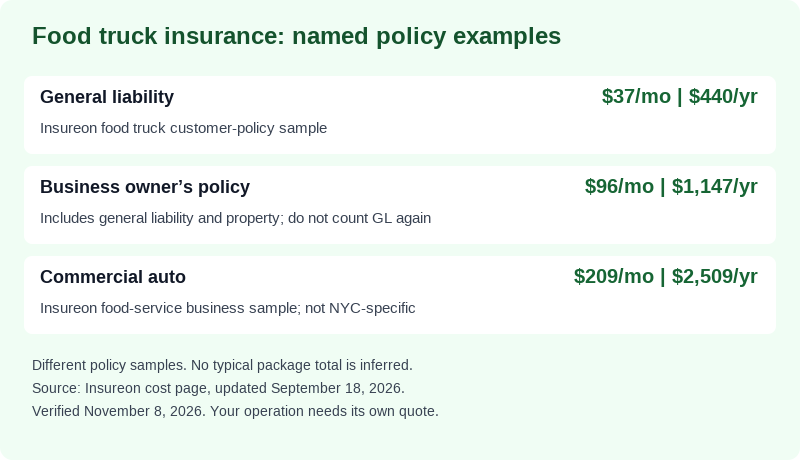
Insureon customer-policy examples are $37/month ($440/year) for general liability, $96/month ($1,147/year) for BOP and $209/month ($2,509/year) for commercial auto. Different samples; BOP includes GL. These are not national averages, NYC quotes or an additive total. Your operation needs its own coverage quote.
Insureon reports $37 per month for general liability, $96 for a business owner’s policy, and $209 for commercial auto in its respective customer samples. Use the monthly and annual figures below to compare policy types. For your own budget, request a quote covering your truck, equipment, drivers, and vending locations.
Prices checked November 27, 2026. The Insureon food truck cost page reports the customer-policy examples below. Use the commercial food truck insurance checklist to compare coverage and contract terms.
Named policy examples: monthly and annual
| Policy | Source-reported monthly example | Source-reported annual example | Published terms and scope |
|---|---|---|---|
| General liability (GL) | $37 | $440 | $1 million per occurrence, $2 million aggregate. Ask the insurer about applicable deductibles. |
| Business owner’s policy (BOP) | $96 | $1,147 | Includes GL and property. Published example lists $1 million per occurrence, $2 million aggregate, and a $1,000 deductible. |
| Commercial auto | $209 | $2,509 | Food-service business auto sample. Quote liability limits and physical-damage deductibles for your vehicle. |
Do not add these rows together. BOP already includes general liability, so adding GL and BOP would overlap coverage. The rows also represent different policy samples, not three quotes for one identical truck. Even adding BOP and auto would not establish a typical total: limits, deductibles, eligible businesses and other coverage needs can differ.
Monthly and annual numbers are quoted separately as published. They are not forced to equal one another multiplied or divided by twelve. A payment plan can have a deposit, installment charges or a different schedule; ask the quoting carrier for the amount actually due at binding and at each installment.
Why an advertised starting price is different
FLIP’s food truck page advertises starting prices of $25.92 per month or $299 per year and explicitly states that the program is not a commercial auto policy. Its listed general liability limits are $1 million per occurrence and $2 million aggregate. Those two limits mean different things; the aggregate is not a $2 million limit for every claim.
Treat this as a named provider’s starting offer subject to its terms, eligibility and selected coverage. It is not an all-in price for every truck or a substitute for vehicle coverage. Before comparing it with another quote, identify what is insured, where the coverage applies, the deductible and any endorsements you need. A lower headline price can simply cover fewer risks.
What moves your own quote
Vehicle and equipment. Give the agent the truck’s VIN, age, value, garaging location, operating radius and drivers. Identify permanently installed kitchen equipment and movable gear separately. Ask which policy covers each item while parked, driving, stored or used at an event; do not assume auto physical damage covers every piece of equipment or every breakdown.
Menu and operations. Explain cooking methods, fuel, refrigeration, catering and the places you sell. A description that fits a coffee cart may miss risks on a truck with fryers or propane. Use the equipment list to assemble an inventory with replacement values, photographs and receipts.
Employees and payroll. Workers’ compensation requirements and pricing depend on the jurisdiction, business structure, worker classification and payroll. Check the applicable agency rules and ask how seasonal staffing affects premium adjustments. Do not replace a payroll-based quote with an unsupported per-employee annual estimate.
Limits and contracts. A venue, commissary, lender or client may require limits or endorsements beyond the applicable legal requirements. Collect those documents before requesting quotes. Keep per-occurrence, aggregate, vehicle liability and property limits in separate columns. A contractual requirement for one event is not a nationwide statutory minimum.
Claims and drivers. Disclose the information requested by the carrier accurately. Claims and driving histories can affect eligibility and premiums, but this guide does not assign an unsupported percentage surcharge to an accident or claim.
Compare bundling and deductibles without a promised saving
A BOP generally combines general liability and commercial property. It does not automatically include commercial auto or workers’ compensation. A specialist package may combine additional policies, but the proposal must identify what is included. Ask for equivalent stand-alone and package options if available, and compare the actual coverage and total quoted price.
Bundling can affect premiums; there is no verified fixed saving percentage here. Nor does one program necessarily mean one deductible for every claim. Read each coverage section and endorsement before treating a combined invoice as a single policy.
A higher applicable deductible can change the quote while increasing your own financial exposure. Ask for otherwise identical options and compare the premium difference with the amount you would need to pay on a covered loss. Keep enough cash to fund that deductible without stopping service. This guide does not claim that changing it saves a set percentage.
Get a usable quote and payment schedule
- List the vehicle, drivers, equipment, operating locations and payroll that every insurer should use.
- Attach the limits and additional-insured terms required by your venues, commissary and lender.
- Ask which food-related claims, equipment losses and interruption triggers are covered or excluded.
- Request the annual premium, deposit, installment charges and payment dates in writing.
- Compare proposals with the same limits, deductibles and endorsements, and ask the broker to explain any differences.
A certificate of insurance summarizes evidence of coverage; confirm that any required additional-insured endorsement is actually in place. For towed operations, explain the tow vehicle and trailer separately; see our food trailer insurance guide for the coverage questions to raise rather than assuming the truck examples transfer directly.
Put the quoted expense into your operating plan
Use the carrier’s actual payment schedule for cash-flow planning and its quoted annual expense for your annual budget. Check whether amounts already included in a package are being counted again as separate policies. Keep insurance distinct from license fees, deposits and other opening expenses.
The profit calculator lets you test the recurring insurance expense alongside your own sales and operating assumptions. The startup calculator offers preset scenarios; its preset insurance amount is a planning assumption, not a broker quote or a validated market statistic. Use your assembled budget as the startup-investment input in the profit tool when checking payback.
Frequently asked questions
How much does food truck insurance cost per year?
Insureon reports separate customer-policy examples: general liability $440 per year, BOP $1,147 per year, and commercial auto $2,509 per year. These are different samples, not a complete package total or a national average.
How much is food truck insurance per month?
Insureon lists general liability at $37 per month, BOP at $96 per month, and commercial auto at $209 per month. Monthly and annual figures are reported separately by the source; actual payment schedules require a quote.
Can I add the general liability, BOP and auto examples together?
No. A BOP includes general liability, and the reported prices come from different policy samples. Adding them would double-count coverage and would not estimate a typical total.
Does a low advertised liability price include commercial auto?
Not necessarily. FLIP advertises starting prices of $25.92 per month or $299 per year and explicitly says its program is not a commercial auto policy. Review coverage and exclusions before comparing.
Can bundling or a higher deductible lower my premium?
They may affect the quote, but no fixed percentage saving is established here. Compare equivalent coverage. A higher applicable deductible increases what you must fund yourself on a covered claim.
Methodology & Assumptions
Cost ranges are planning models assembled from the line items and assumptions shown in this guide. They are not quotes or guaranteed market averages. This page identifies 3 cited sources; official fees and requirements should be checked against those links. AI tools may assist with organization and drafting, but they are not a source and no independent food-truck operator review is claimed. Local rules and prices can change; verify them before committing funds. Last updated: 2026-11-27.
Sources & verification
- Insureon — Food truck insurance costs Verified 2026-11-27. Platform customer-policy statistics; auto sample includes food service businesses.
- FLIP — Food truck insurance Verified 2026-11-27: advertised starting prices $25.92/month or $299/year; not a commercial auto policy.
- U.S. Small Business Administration — Get business insurance Coverage categories and risk-based purchasing guidance; not a source for the sample prices.
Regulations and fees change. Confirm the current application, fee schedule, and operating rules with the issuing agency before purchasing a vehicle or signing a commissary agreement.