Food Truck Monthly Profit: A Realistic Month-by-Month Breakdown
Quick answer
This guide models food-truck net profit scenarios from $3,000–$10,000 per month, with stronger cases around $5,000–$7,000. These are planning outputs, not a measured national average; replace orders, ticket size, service days, food cost, labor, and overhead with your own operating evidence.
Food truck monthly profit typically ranges from $3,000 to $10,000 for most operators, with top-performing trucks earning $15,000+ per month during peak season. The actual number depends heavily on cuisine type, location strategy, days worked per month, and whether you focus on street vending or events.
Across all food truck types, the average monthly net profit lands around $5,000-$7,000 once the business is established. But “per month” hides a lot of swing — a great July and a quiet January can differ by 50% or more. This guide breaks down monthly revenue ranges, fixed and variable costs, slow vs. peak months, and the simple ticket math that drives the whole number. Use our profit calculator to model your specific monthly numbers.
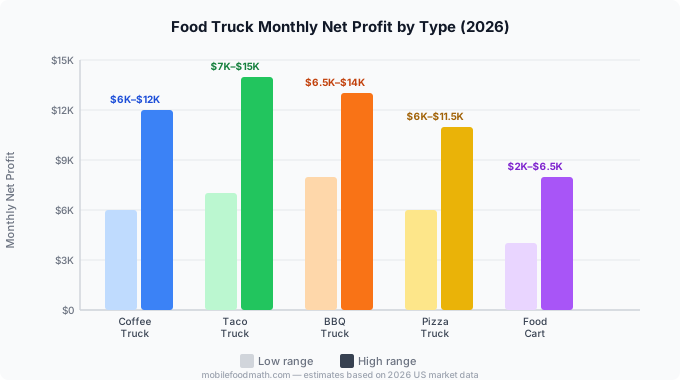
How much does a food truck make a month?
The honest answer is a range, not a single figure. A part-time cart working farmers markets two days a week is in a completely different bracket than a financed truck running six days a week in a dense lunch district. To make the question concrete, it helps to separate monthly revenue (gross sales) from monthly net profit (what you keep after every cost).
For an established, full-time truck in a mid-size US market, expect:
- Monthly revenue: $15,000 – $40,000
- Monthly net profit: $3,000 – $10,000
- Net margin: roughly 15% – 28%
Part-time and seasonal operators land lower in absolute dollars but often run higher margins because they skip a financed truck payment and carry fewer fixed costs. For the national picture across operating models, see how much food trucks make.
Monthly revenue ranges by cuisine type
Revenue is the top of the funnel — everything else is a percentage of it. Cuisine type matters because it sets your average ticket, your food cost percentage, and how fast the line moves.
| Cuisine Type | Monthly Revenue | Monthly Costs | Monthly Profit | Margin |
|---|---|---|---|---|
| Tacos | $18K – $35K | $14K – $26K | $4K – $9K | 20-28% |
| BBQ | $18K – $40K | $14K – $30K | $3.5K – $10K | 15-25% |
| Pizza | $18K – $42K | $13K – $31K | $4.5K – $11K | 22-28% |
| Coffee | $10K – $22K | $7K – $16K | $3K – $6K | 25-35% |
| Ice Cream (peak) | $12K – $22K | $8K – $14K | $3.5K – $8K | 25-35% |
| General/Avg | $15K – $30K | $11K – $22K | $4K – $8K | 18-28% |
Coffee and ice cream show the highest margins because food cost is low (often 18-25% of revenue) and a single person can run the window. Pizza and tacos generate the highest absolute profit because they pair a strong average ticket with fast throughput. BBQ has the widest swing — protein costs and long cook times can squeeze margins if volume is inconsistent, as the BBQ truck profit margin breakdown details.
The ticket math: average ticket × orders per day
Before you trust any revenue range, sanity-check it with the only formula that actually generates the number:
Monthly revenue = average ticket × orders per day × days worked per month
A few worked examples for a truck with a $13 average ticket:
| Orders/Day | Days/Month | Avg Ticket | Monthly Revenue |
|---|---|---|---|
| 50 | 20 | $13 | $13,000 |
| 75 | 22 | $13 | $21,450 |
| 100 | 24 | $13 | $31,200 |
| 130 | 26 | $13 | $43,940 |
This is why route density beats almost everything else. Going from 50 to 100 orders per day on the same number of service days more than doubles revenue, and your fixed costs stay flat — so margin expands too. Raising the average ticket by even $2 (a drink, a side, a combo upsell) on 2,000 monthly orders adds $4,000 of nearly pure-margin revenue.
Monthly fixed costs: commissary, insurance, permits, loan
Fixed costs are the bills that arrive whether you sell zero tacos or a thousand. They set your monthly break-even floor.
| Cost Item | Typical Range |
|---|---|
| Insurance | $200 – $500 |
| Permits & Licenses | $100 – $400 |
| Commissary Rent | $500 – $1,500 |
| Truck Payment (if financed) | $500 – $1,500 |
| Storage & Parking | $200 – $600 |
| Software & POS | $50 – $150 |
| Total fixed | $2,500 – $5,000 |
Two line items deserve a closer look. Commissary rent is often the single largest fixed cost for operators who don’t own a kitchen — many cities legally require a licensed commissary for prep and overnight storage, and rates vary widely by metro. See the full breakdown in commissary costs. Insurance bundles general liability, commercial auto, and sometimes workers’ comp; the monthly figure depends on coverage limits and claims history, detailed in insurance costs.
If you bought your truck outright, you erase the $500–$1,500 monthly payment — which can be the difference between a $4,000 and a $6,000 net month. That single decision is why two trucks with identical sales can report very different monthly profit.
Monthly variable costs: food, fuel, labor
Variable costs rise and fall with sales. They’re the bulk of your spending and the easiest place to leak profit.
| Cost Item | Typical Range | % of Revenue |
|---|---|---|
| Food & Ingredients | $4,000 – $10,000 | 28-38% |
| Labor (1-2 employees) | $3,000 – $6,000 | 20-30% |
| Fuel (truck + generator) | $500 – $1,500 | 3-6% |
| Packaging & Supplies | $300 – $800 | 2-4% |
| Marketing & Commissions | $200 – $600 | 1-3% |
| Total variable | $8,000 – $18,900 | **— ** |
Food cost is the number to watch weekly, not monthly — by the time a 40% food cost shows up on a monthly P&L, you’ve already lost the margin. Trucks that hold food cost at 30-32% almost always outperform on profit. Labor is the second lever: an owner who works the window themselves on slow days can swing 5-8 points of margin, though it isn’t sustainable long-term. Fuel covers both driving to locations and running the generator during service, and it climbs fast for trucks with long commutes to events.
Net monthly profit by sales volume
Putting fixed and variable costs together, here’s how net profit scales as a typical truck climbs the volume ladder (assuming ~32% food cost, ~25% labor, and $3,500 in fixed costs):
| Monthly Revenue | Food + Variable | Fixed Costs | Net Monthly Profit | Margin |
|---|---|---|---|---|
| $12,000 | $8,200 | $3,500 | $300 | 3% |
| $18,000 | $11,900 | $3,500 | $2,600 | 14% |
| $25,000 | $16,300 | $3,500 | $5,200 | 21% |
| $35,000 | $22,400 | $3,500 | $9,100 | 26% |
| $45,000 | $28,500 | $3,500 | $13,000 | 29% |
Notice the shape: profit doesn’t grow linearly with revenue — it accelerates. Once revenue clears the fixed-cost hurdle (around $13,000–$15,000 for most trucks), each additional dollar of sales drops far more profit to the bottom line because the fixed costs are already covered. This is operating leverage, and it’s the entire reason high-volume trucks feel disproportionately profitable. To find your own crossover point, run the numbers through the break-even calculator, and for how to read that monthly floor against your startup capital and recovery timeline, see the food truck break-even analysis guide.
Slow months vs. peak months
The “monthly profit” most people quote is really a peak-season number. Annualize it and reality sets in.
| Season | Monthly Profit Impact | Strategy |
|---|---|---|
| Spring (Mar-May) | Baseline | Build route, test locations |
| Summer (Jun-Aug) | +30-50% above baseline | Peak season, maximum hours |
| Fall (Sep-Nov) | Baseline to -10% | Events, festivals peak |
| Winter (Dec-Feb) | -20-50% below baseline | Catering, indoor markets, off-season prep |
A truck netting $8,000 in July might net $3,000 in January in a cold-weather market. The smart play is to treat summer profit as partly a reserve for winter, not as your true monthly income. Operators in warm climates (Texas, Florida, Arizona, Southern California) see a flatter curve and can sustain higher average monthly profit year-round, which is one reason those markets are crowded.
Days worked per month: the hidden variable
Two trucks with the same daily sales can report wildly different monthly profit purely because of how many days they operate. A truck working 16 days a month nets roughly two-thirds of one working 24 days — same costs per day, but a third more revenue. Common monthly schedules:
- Part-time / weekends: 8–12 service days → lower revenue, but minimal labor and sometimes no commissary
- Standard full-time: 20–24 service days → the bracket most profit estimates assume
- High-volume / events-heavy: 24–28 service days → maximum revenue, but burnout and equipment wear become real costs
More days isn’t automatically more profit. If days 25–28 are low-traffic locations, they can run at a loss after fuel and labor. Tracking profit per service day, not just per month, tells you which days to cut.
How to improve your monthly profit
For a deeper national view of margins and benchmarks, see food truck profit. The fastest monthly levers:
Route optimization
The single biggest lever is route density. A truck that serves 100 customers in a 4-hour block is far more profitable than one serving 50 in the same window — food cost percentage stays flat, but fixed costs spread over twice the sales. Drop your two weakest locations and replace them, don’t just add hours.
Event and catering mix
Operators who balance street vending (about 70% of days) with events and catering (about 30%) consistently report 20-30% higher monthly profit than street-only trucks. Events allow premium pricing, guaranteed minimums, and predictable volume that smooths out the slow weeks.
Menu focus and upsells
Tight menus (8-12 items) beat sprawling ones (20+ items): less prep, less waste, faster service. Pair that with a disciplined upsell — a drink and a side on every other order — and you raise the average ticket without spending a dollar more on marketing.
Control food cost weekly
Holding food cost at 30-32% instead of letting it drift to 38% is worth 6-8 points of margin. Count inventory, track waste, and reprice or cut any item whose cost has crept up.
Calculate Your Monthly Profit
Use our profit calculator with your specific revenue, costs, and cuisine type to get a personalized monthly profit projection.
Use the Profit CalculatorFrequently asked questions
How much profit does a food truck make per month?
Most food trucks earn $3,000-$10,000 per month in net profit, with the average established truck landing around $5,000-$7,000. The figure depends on cuisine, days worked, and season — peak summer months can run 30-50% above a quiet winter month, so the “monthly” number is really a range.
Which food truck type is most profitable per month?
Pizza trucks and taco trucks tend to have the highest monthly profit potential ($4K-$11K) thanks to low food costs, high volume, and strong average tickets. Coffee and ice cream trucks carry higher margins (25-35%) but lower absolute revenue, so their monthly profit is steadier but smaller.
How long does it take to reach consistent monthly profit?
Most food trucks take 3-6 months to build a repeat customer base and reach consistent monthly profit. The first 2-3 months are typically break-even or slightly negative as you test locations and dial in your route.
What is the biggest monthly expense?
Food and ingredient costs are the largest monthly expense for most trucks (28-38% of revenue), followed by labor (20-30%). Together they make up 50-65% of total monthly costs, which is why controlling food cost weekly matters more than trimming fixed bills.
Can a food truck make $10,000 per month consistently?
Yes — well-run trucks in good locations with tight menus consistently net $10,000+ per month. That usually requires monthly revenue of $35,000-$50,000, a high number of service days, and disciplined cost management. In cold-weather markets, expect that level only during peak season.
Next steps
- Food Truck Profit — National food truck profit margin analysis
- How Much Food Trucks Make — Earnings across operating models
- Commissary Costs — Your largest fixed cost, explained
- Profit Calculator — Calculate your personalized monthly profit
- Break-Even Calculator — Find your monthly break-even point
Methodology & Assumptions
Cost ranges are planning models assembled from the line items and assumptions shown in this guide. They are not quotes or guaranteed market averages. This page identifies 3 cited sources; official fees and requirements should be checked against those links. AI tools may assist with organization and drafting, but they are not a source and no independent food-truck operator review is claimed. Local rules and prices can change; verify them before committing funds. Last updated: 2026-07-28.
Sources & verification
- U.S. Small Business Administration — Break-even point Official contribution-margin and break-even formulas used in the scenarios.
- U.S. Bureau of Labor Statistics — Food service managers Labor-market context only; BLS does not publish a national food-truck-owner profit average.
- USDA Economic Research Service — Food Price Outlook Official food-price trend context for ingredient assumptions.
Regulations and fees change. Confirm the current application, fee schedule, and operating rules with the issuing agency before purchasing a vehicle or signing a commissary agreement.