Ice Cream Truck Menu Pricing: What to Charge in 2026
Quick answer
Ice cream truck prices typically run $2.50–$7 for novelty bars, $4–$8 for scoops, and $3.50–$6.50 for soft serve. Use food cost to set a floor, then adjust for your route or event so 50–70% gross margins survive seasonality and freezer costs.
Ice cream truck menu pricing is different from general food truck pricing. Many items have strong gross margins, but seasonality, route time, freezer reliability, fuel, permits, and waste can erase the advantage if prices are too low. At a glance, this 2026 price list puts packaged bars at $2.50-$7, scoops at $4-$8, soft serve at $3.50-$6.50, and sample menu items at $3.50-$8.
Use this guide to price packaged novelties, scoops, soft serve, toppings, drinks, and combo offers before you print a menu. Whether you are figuring out how much to charge for an ice cream truck cone, building a full ice cream truck menu from scratch, or trying to nail soft serve pricing for a busy summer route, the same cost-and-margin logic applies. The goal is simple: set ice cream truck prices that customers happily pay, that beat the local going rate without scaring anyone off, and that still leave real money after product, packaging, melt, fuel, and card fees.
Why Ice Cream Truck Pricing Is a Special Case
A taco truck or burger truck usually carries food cost in the 28%–35% range, with meaningful labor on every order. Ice cream is the opposite extreme on two fronts. First, food cost on many items is very low — a soft serve cone can cost well under a dollar to serve, and a scoop is often around a dollar including the cone. Second, the markup customers will tolerate is high, because ice cream is an impulse treat tied to weather, kids, and nostalgia rather than to a daily food budget. That combination is what makes the category attractive.
But the low food cost is a trap if you price purely off it. A $0.85 soft serve cone at a “normal” 30% food cost target would sell for under $3.00 — and you would be leaving money on the table while still absorbing fuel, melt, freezer failures, permit fees, and the hours you spend driving a route with no sales. Ice cream truck menu pricing should lean on perceived value and local market rates as much as on a food-cost formula. The formula sets your floor; the market and the moment set your ceiling. Hedge everything that follows: these are planning ranges, and a beach boardwalk in July supports very different numbers than a quiet residential route in May.
Ice Cream Truck Menu Price Benchmarks
| Item Type | Typical Customer Price | Typical Food Cost % | Notes |
|---|---|---|---|
| Packaged novelty bars | $2.50-$5.00 | 25%-45% | Easy service, lower labor, margin depends on wholesale cost. |
| Premium packaged items | $4.00-$7.00 | 30%-50% | Higher ticket, but branded items can have thinner margin. |
| Scoops | $4.00-$8.00 | 15%-30% | Strong margin if portion control is consistent. |
| Soft serve cone | $3.50-$6.50 | 12%-25% | Good margin, but machine cost and maintenance matter. |
| Sundaes | $6.00-$10.00 | 18%-32% | Toppings raise ticket and perceived value. |
| Floats and shakes | $6.00-$11.00 | 20%-35% | Labor and service speed matter. |
| Bottled drinks | $2.00-$4.00 | 25%-45% | Useful add-on, not the core profit engine. |
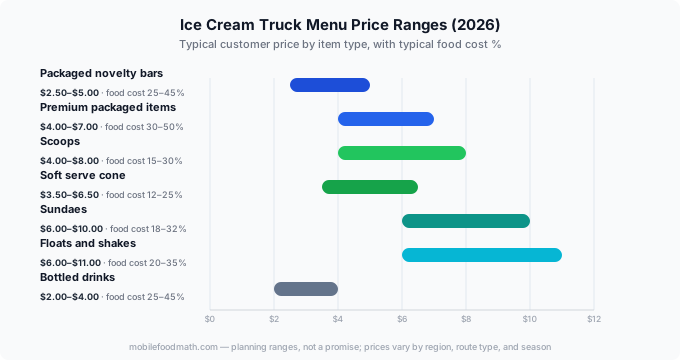
These are planning ranges, not a promise that every city can support the same price. Test against local competitors, events, school zones, parks, and neighborhood routes. As a rule of thumb, packaged novelties carry the easiest service but the thinnest dollar margin per item, while soft serve and scoops require equipment and labor but reward you with the strongest percentage margins. A healthy ice cream truck menu usually blends both: fast packaged items to keep a route line moving, plus a couple of made-to-order anchors that lift the average ticket.
When operators ask “how much should an ice cream truck charge?” the honest answer is a band, not a single number. The table above is your starting band. Then adjust up for premium locations and down only when a route is clearly price-sensitive. For a deeper look at how these prices roll up into monthly take-home, pair this page with the ice cream truck profit guide.
Understanding Food Cost, Markup, and Margin
Three numbers get confused constantly, so pin them down before you price anything.
- Food cost percentage is what the product and its packaging cost divided by the menu price. A $5.00 cone that costs you $1.00 to serve runs a 20% food cost.
- Markup is how many times you multiply cost to reach price. That same cone is a 5x markup.
- Gross margin is the price minus the cost, expressed as a percentage of the price — 80% in that example.
Ice cream is one of the rare mobile-food categories where 70%–85% gross margins on made-to-order items are realistic, which is exactly why the business is appealing. But “very low food cost plus high markup” only translates into profit if volume is high enough to cover the fixed costs of running a truck. A 80% margin on twelve cones a day will not pay for fuel and insurance. This is the single most important mindset for ice cream truck prices: protect the margin per item, but never forget that route volume and operating days are what turn that margin into income.
| Concept | Formula | Example ($1.00 cost, $5.00 price) |
|---|---|---|
| Food cost % | cost ÷ price | 20% |
| Markup | price ÷ cost | 5.0x |
| Gross margin % | (price − cost) ÷ price | 80% |
| Gross profit $ | price − cost | $4.00 |
Pricing Formula
Use the same basic formula as other food trucks:
Menu Price = Total Cost Per Serving / Target Food Cost %For ice cream, total cost per serving should include:
- Product cost.
- Cone, cup, spoon, napkin, or wrapper.
- Toppings or syrup.
- Waste and melt allowance.
- Labor time for made-to-order items.
- Card processing fees if most customers pay by card.
Use the menu pricing calculator to test each item.
Sample Ice Cream Truck Menu
| Menu Item | Cost Per Serving | Target Food Cost | Calculated Price | Menu Price |
|---|---|---|---|---|
| Basic novelty bar | $1.20 | 35% | $3.43 | $3.50 |
| Premium character bar | $2.10 | 42% | $5.00 | $5.00 |
| Single scoop cone | $1.05 | 22% | $4.77 | $5.00 |
| Double scoop cup | $1.80 | 24% | $7.50 | $7.50 |
| Soft serve cone | $0.85 | 18% | $4.72 | $5.00 |
| Sundae | $1.70 | 25% | $6.80 | $7.00 |
| Shake | $2.25 | 30% | $7.50 | $8.00 |
Round prices for speed. Ice cream trucks often do better with simple, easy-to-say prices than complicated decimals. At a busy window, “five dollars” moves the line faster than “four seventy-seven,” and round numbers also make cash handling and change much quicker. Run each line through the menu pricing calculator with your real local costs, then round up to the nearest clean price rather than down.
Soft Serve Pricing in Detail
Soft serve deserves its own section because it is where most operators either win big or quietly lose money. The per-serving product cost is genuinely low — often $0.60–$1.00 for a standard cone including the cone itself — so soft serve pricing tends to produce the best percentage margins on the truck. A $5.00 soft serve cone at $0.85 cost is an 83% gross margin.
The catch is everything around the mix:
- Machine cost and downtime. A soft serve machine is a real capital expense, and a machine that goes down on a hot Saturday is lost revenue you cannot recover.
- Mix waste. Soft serve mix left in the hopper overnight or discarded during cleaning is pure cost with no sale attached. Build a small waste allowance into the per-serving cost.
- Portion drift. Without a trained hand, soft serve portions creep up. A few extra seconds of pull on every cone quietly raises your real food cost.
- Power and cleaning. Generator fuel to keep the machine cold and the labor to break it down and sanitize it are costs that never show up on the menu but always show up on the P&L.
For soft serve pricing, most operators land basic cones in the $3.50–$6.50 range and use size tiers (kiddie, regular, large) plus dip cones and topping crunches to lift the ticket. Charging $1.00–$1.50 for a chocolate dip or sprinkle coat is one of the highest-margin upsells on the entire menu.
Packaged vs Soft Serve Pricing
Packaged ice cream is operationally simpler. You can move quickly, train staff faster, and avoid machine maintenance. The tradeoff is that wholesale cost can make margins thinner.
Soft serve and scoops can produce stronger margins, but only if:
- The equipment is reliable.
- Portions are controlled.
- Service speed stays high.
- Food safety and cleaning routines are consistent.
- Demand is high enough to justify equipment cost.
If you are still choosing the format, compare the ice cream truck vs cart guide and the ice cream truck startup cost calculator.
How to Raise Average Ticket With Combos and Upsells
Do not rely only on raising base prices. Build menu architecture that increases order value. The general principles here mirror what works for any mobile vendor — see the broader menu pricing guide — but ice cream has its own high-margin upsell levers.
- Offer topping upgrades.
- Bundle drink plus novelty.
- Create small, regular, and premium sizes.
- Use family packs at parks and events.
- Add seasonal specials.
- Put the highest-margin items in the most visible menu position.
Example:
| Offer | Price | Why It Works |
|---|---|---|
| Single scoop | $5.00 | Entry item. |
| Double scoop | $7.50 | Higher ticket with modest extra product cost. |
| Sundae upgrade | +$2.00 | Toppings increase perceived value. |
| Family bundle | $22.00 | Speeds multi-person orders. |
Seasonality and Route Pricing
Ice cream demand is seasonal in many markets. Your summer menu may support higher prices than spring or fall, especially at events. But route-based customers can be more price-sensitive than event customers.
Consider separate pricing assumptions for:
- Neighborhood routes.
- Parks and beaches.
- School-adjacent routes where allowed.
- Festivals and fairs.
- Private events.
- Catering packages.
Use the ice cream truck profit calculator to model peak months, off-season revenue, melt, route fuel, and freezer costs.
Route Pricing vs Event Pricing
The biggest pricing lever after the menu itself is where you sell. Route customers — the neighborhood kids and parents who hear the music — are repeat buyers who notice price changes and have alternatives at the grocery store. Event customers — festival-goers, fair attendees, private-party guests — are a captive audience in a treat-buying mood, and they expect to pay event prices. Running the same menu at the same prices in both settings leaves money on the table at events and risks pricing yourself out on routes.
A practical approach is to keep one base menu and apply an event uplift, rather than maintaining two entirely separate menus. Many operators add roughly 15%–35% at premium events, and bundle catering or private parties as a flat package with a minimum.
| Setting | Pricing Posture | Example Cone Price | Why |
|---|---|---|---|
| Neighborhood route | Base / value | $4.00–$5.00 | Repeat buyers, grocery-store alternatives, price memory. |
| Parks and beaches | Base to slight premium | $5.00–$6.00 | Captive, sunny-day impulse, less competition. |
| School-adjacent (where allowed) | Value, kid-friendly tiers | $3.00–$5.00 | Small budgets, high frequency, add a kiddie size. |
| Festivals and fairs | Premium | $6.00–$8.00 | Captive crowd, expected event pricing, higher costs. |
| Private events / catering | Flat package + minimum | Package | Guaranteed volume, no melt-driven downtime risk. |
For catering and private events, quoting a per-head or flat package (for example, unlimited soft serve for a set number of guests with a minimum spend) often beats à la carte, because it guarantees revenue regardless of how the day flows and removes the melt-and-waste gamble of an open route.
Cash vs Card Pricing
Payment method quietly changes your margins. Card processing typically takes 2%–3.5% plus a small per-transaction fee, and on a $4–$5 ticket that fixed fee bites harder in percentage terms than it does on a restaurant check. As more customers tap and fewer carry cash, you have a few options:
- Price card fees into the menu. The simplest approach: set every price assuming most customers pay by card, so the fee is already absorbed. Your food-cost target should include the processing fee as a cost line.
- Offer a cash price or card surcharge. Some operators post a small cash discount or card surcharge. This can protect margin but adds friction and signage requirements, and a few jurisdictions restrict surcharging — check local rules.
- Keep prices round either way. Whatever you choose, round numbers keep the line moving and make cash change fast.
The practical default for a modern ice cream truck is to assume card-heavy traffic and bake the fee into every price, then treat any cash as a small margin bonus. Test each item with the processing fee included using the menu pricing calculator.
Common Pricing Mistakes
- Pricing every item at the same margin.
- Ignoring melted or damaged inventory.
- Underpricing premium packaged items.
- Forgetting spoons, cups, napkins, cones, and toppings.
- Letting staff over-portion scoops.
- Assuming route demand equals event demand.
- Printing a menu before testing service speed.
Price Your Ice Cream Menu From Your Actual Costs
Enter product, cone, topping, packaging, labor, and card costs to calculate a selling price for your target food-cost percentage.
Use the Menu Pricing CalculatorFrequently Asked Questions
What is a good food cost percentage for an ice cream truck?
Many ice cream truck items target 15%-30% food cost, but packaged branded novelties can run higher. The right target depends on wholesale cost, route type, and how much labor the item requires.
How much should an ice cream truck charge for a cone?
Many operators price basic cones around $4-$6 and premium or double-scoop items higher. Use your actual product cost and target food cost percentage rather than copying another truck’s menu.
Are packaged ice cream bars profitable?
They can be profitable because service is fast and labor is low, but wholesale cost matters. Premium packaged items may need higher prices to protect margin.
Should an ice cream truck use round prices?
Usually yes. Round prices speed up ordering, reduce friction, and make route service easier.
How much more can I charge at events versus my route?
Many operators add roughly 15%–35% at festivals, fairs, and premium locations versus their neighborhood route price, because event crowds are captive and expect event pricing. Keep one base menu and apply an uplift rather than juggling two separate menus, and quote private parties as a flat package with a minimum.
Next Steps
- Menu Pricing Calculator — Price each ice cream item from cost and target margin.
- Ice Cream Truck Startup Cost Calculator — Compare equipment formats.
- Ice Cream Truck Profit Guide — Model seasonal profit and route assumptions.
- Food Truck Break-Even Calculator — Turn menu prices into daily order targets.
Methodology & Assumptions
Cost ranges are planning models assembled from the line items and assumptions shown in this guide. They are not quotes or guaranteed market averages. This page identifies 2 cited sources; official fees and requirements should be checked against those links. AI tools may assist with organization and drafting, but they are not a source and no independent food-truck operator review is claimed. Local rules and prices can change; verify them before committing funds. Last updated: 2026-09-11.
Sources & verification
- USDA Economic Research Service — Food Price Outlook Official food-price trend context; local wholesale quotes determine actual item costs.
- U.S. Small Business Administration — Break-even point Contribution-margin framework used in the pricing examples.
Regulations and fees change. Confirm the current application, fee schedule, and operating rules with the issuing agency before purchasing a vehicle or signing a commissary agreement.