How Much Do Food Trucks Make? Realistic Income Ranges
“How much do food trucks make?” is the first question almost every aspiring owner asks, and the honest answer is: it depends, but the ranges are knowable. A food truck is a small business on wheels, so its income swings with location, menu, days worked, and how tightly the owner controls costs. Below are realistic US 2026 ranges for daily, monthly, and annual revenue, plus how that revenue turns into actual take-home profit. Use the numbers as benchmarks, not promises, and plug your own assumptions into the profit calculator to see where your concept lands.
How much does a food truck make in a day?
Daily revenue is the building block for every other number on this page. A typical full-service day for an established truck in a decent market falls somewhere in these ranges:
| Day type | Typical gross revenue | Transactions (at ~$12 avg ticket) |
|---|---|---|
| Slow weekday / new truck | $200 – $600 | 17 – 50 |
| Average lunch service | $600 – $1,200 | 50 – 100 |
| Strong location / busy day | $1,200 – $2,000 | 100 – 165 |
| Festival or large event | $2,000 – $5,000+ | 165 – 415+ |
Most owner-operated trucks doing regular street and lunch service land around $700 to $1,200 on a normal day once they have a customer base. New trucks often sit at the bottom of the range for the first several months while building regulars and dialing in locations. Average ticket size matters enormously: a coffee truck at a $6 ticket needs far more transactions than a BBQ truck at an $18 ticket to hit the same gross.
How much does a food truck make in a month?
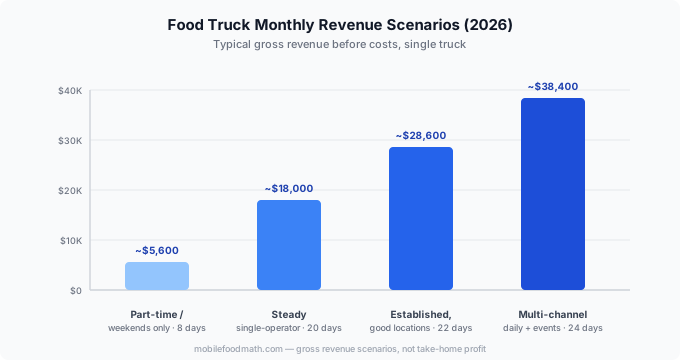
Monthly revenue is daily revenue multiplied by how many days you actually operate. This is where a lot of optimistic projections fall apart, because few trucks serve seven days a week. A realistic operating month is 18 to 24 service days.
| Scenario | Avg revenue/day | Service days/month | Monthly revenue |
|---|---|---|---|
| Part-time / weekends only | $700 | 8 | ~$5,600 |
| Steady single-operator | $900 | 20 | ~$18,000 |
| Established, good locations | $1,300 | 22 | ~$28,600 |
| Multi-channel (daily + events) | $1,600 | 24 | ~$38,400 |
So monthly gross revenue typically ranges from about $5,000 for a part-time operation to $35,000+ for a busy, well-located truck. Remember this is gross sales, not what you keep. For a deeper breakdown of how monthly sales convert to take-home pay, see the monthly profit guide.
How much does a food truck make a year?
Annual revenue depends heavily on climate and how many months you can run. A truck in Phoenix or Austin can operate year-round; one in Minneapolis may effectively shut down for the coldest months.
| Operation level | Annual gross revenue |
|---|---|
| Part-time / seasonal | $40,000 – $90,000 |
| Average full-time single truck | $150,000 – $290,000 |
| Strong, established truck | $250,000 – $500,000 |
| Top performers / multi-truck | $500,000 – $1,000,000+ |
For planning, this guide models a full-time US food truck in a $150,000 to $300,000 annual revenue band. Results above $500,000 are possible for high-volume concepts with prime locations, strong event calendars, or multiple trucks, but they should not be treated as a national median. Use the middle band only as a scenario, then replace its order count, ticket size, operating days, and costs with your own evidence.
Gross revenue vs net profit: the number that actually matters
Revenue is what customers pay you. Profit is what is left after every cost is paid. These are wildly different numbers, and confusing them is the most common reason new owners feel blindsided. A truck grossing $250,000 a year does not put $250,000 in anyone’s pocket.
A simplified annual walkthrough for a truck grossing $250,000:
| Line item | % of revenue | Annual amount |
|---|---|---|
| Gross revenue | 100% | $250,000 |
| Food & beverage cost (COGS) | 30% | $75,000 |
| Labor (staff, not owner) | 25% | $62,500 |
| Fuel, propane, maintenance | 6% | $15,000 |
| Commissary / kitchen rent | 5% | $12,500 |
| Permits, insurance, licensing | 4% | $10,000 |
| Marketing, supplies, fees, misc. | 5% | $12,500 |
| Net profit (owner’s earnings) | ~25% | ~$62,500 |
In this example the owner clears roughly $62,500, which is also their effective salary if they work in the truck. Margins shift with every assumption, so model your own version in the profit calculator. For a fuller treatment of the cost stack, read the food truck profit guide.
What profit margin should a food truck expect?
Net profit margins for food trucks typically range from 6% to 9% for struggling or over-staffed operations up to 20% to 30% for lean, owner-run trucks with good cost control. The single biggest swing factor is whether the owner pays themselves a separate wage or counts their own labor as profit.
- Food cost (COGS) usually runs 28% to 35% of revenue. Keeping it near 30% is a healthy target.
- Labor runs 20% to 30%. Solo operators effectively keep this in their pocket.
- Overhead (fuel, commissary, permits, insurance) commonly totals 15% to 25%.
A well-run truck where the owner also works the window can realistically keep 20% to 28% of revenue as combined salary-plus-profit. Tight menu pricing protects these margins, which is why menu pricing is worth getting right before you ever serve a customer.
Are food trucks profitable?
Yes, food trucks can be genuinely profitable, but profitability is not automatic and the failure rate is real. Trucks have a structural advantage over brick-and-mortar restaurants: dramatically lower rent and the ability to chase demand by moving to where the crowds are. That flexibility is why a truck can hit positive cash flow faster than a restaurant.
The trucks that succeed tend to share a few traits: a focused menu that is fast to execute, consistent high-traffic locations or a strong event schedule, disciplined food costs, and an owner who works in the business early on. The ones that struggle usually over-spent on the build, picked low-traffic spots, or priced too low. Knowing your break-even point keeps you honest, run your fixed and variable costs through the break-even calculator to see how many covers a day you need just to stop losing money.
Food truck income by cuisine
Different concepts have very different economics. High average tickets, low ingredient costs, and fast service all push profit up. Here are typical ranges for established trucks in solid markets.
| Cuisine | Avg ticket | Food cost % | Typical annual revenue | Notes |
|---|---|---|---|---|
| Tacos / Mexican | $9 – $14 | 28% – 32% | $180k – $400k | Fast service, strong volume, popular nationwide |
| Coffee / drinks | $5 – $8 | 18% – 25% | $120k – $300k | Low food cost, high margin, morning-heavy |
| BBQ | $14 – $22 | 30% – 38% | $200k – $450k | High ticket, slow prep, strong event seller |
| Pizza | $10 – $16 | 25% – 30% | $180k – $380k | Good margins, equipment-heavy build |
| Ice cream / dessert | $5 – $9 | 22% – 30% | $90k – $250k | Highly seasonal, weather-dependent |
| Burgers / American | $10 – $15 | 30% – 35% | $170k – $360k | Broad appeal, ingredient costs add up |
Coffee and dessert trucks win on margin per dollar of food cost; BBQ and burgers win on ticket size; tacos win on raw volume and broad appeal. None of these ranges is a guarantee, they assume consistent operation and reasonable locations. For a closer look at the two highest-volume savory concepts, see the BBQ truck profit margin and taco truck profit margin breakdowns, or compare how each type stacks up on food truck monthly profit.
High season vs low season
Seasonality is one of the most underestimated income factors. Outdoor warm-weather months (roughly May through September in most of the US) can produce 60% to 70% of a year’s revenue. Winter can drop daily sales by half or more in cold climates, and many seasonal trucks simply park.
Smart operators plan for the swing: building a cash cushion during peak months, leaning on indoor events, private catering, and corporate lunch contracts in winter, and sometimes scaling staff down to owner-only in the slow season. If your projections assume even revenue across all twelve months, they are almost certainly too optimistic.
Daily street service vs events and catering
Where you earn changes how much you earn. The two big channels behave very differently:
- Daily / street service: steady but capped by foot traffic. Predictable, lower per-day ceiling, ideal for building regulars and brand recognition.
- Events, festivals, and catering: lumpy but high-upside. A single festival day can match a full week of street sales, and private catering often books at a guaranteed minimum (commonly $1,500 to $5,000+ per event) with far less weather risk.
The most profitable trucks usually blend both: reliable lunch spots Monday through Friday for baseline cash flow, plus weekend events and weekday catering for the margin spikes. Relying only on walk-up street traffic leaves a lot of income on the table.
How much does a food truck owner actually take home?
This is the question behind the question. After paying staff, food, fuel, and overhead, a typical full-time owner-operator in the US realistically takes home $40,000 to $90,000 per year, with experienced operators in strong markets reaching $100,000 or more, and many first-year owners earning well below that while they build.
Two big caveats:
- In year one, much of the “profit” often goes back into paying down the startup costs of the build, so take-home pay is frequently lower than the steady-state numbers above.
- Owner labor is real money. If you work 50+ hours a week in the truck, part of your “profit” is really wages you would otherwise pay an employee. Counting it as pure profit overstates the business’s true margin.
What changes how much a food truck makes
If you want to move your numbers, these are the levers that matter most, roughly in order of impact:
- Location and foot traffic — the biggest single factor. The same truck can double its revenue by moving from a quiet corner to a busy lunch district or event.
- Days worked — 24 service days a month versus 12 is a 2x difference in revenue with the same truck and menu.
- Menu price and ticket size — a $2 increase in average ticket on 80 daily transactions adds about $160 a day, or roughly $3,800 a month, almost straight to the bottom line.
- Food cost control — shaving COGS from 35% to 30% on $250k of revenue is $12,500 more profit a year.
- Labor model — solo operation versus a full crew can be the difference between a 10% and a 25% margin.
- Menu speed — faster service means more transactions during the lunch rush, which is when most daily revenue is earned.
You can model every one of these in the profit calculator by adjusting ticket size, daily covers, food cost, and days worked.
A worked example
Say you run a taco truck, work the window yourself, and add one part-time helper at peak.
- Average ticket: $12
- Average transactions per day: 85 → daily revenue ≈ $1,020
- Service days per month: 22 → monthly revenue ≈ $22,440
- Annual revenue (10 active months) ≈ $224,400
Apply typical taco-truck costs: food at 30% ($67,300), one part-timer plus payroll at 12% ($26,900), fuel/propane/maintenance at 6% ($13,500), commissary and permits at 8% ($18,000), marketing and misc at 5% ($11,200). Total costs ≈ $136,900, leaving net profit of roughly $87,500 as the owner’s combined wage and profit. Drop daily transactions to 60 and the same truck nets closer to $45,000, which shows how sensitive the bottom line is to volume.
Frequently asked questions
How much do food trucks make a year on average? A typical full-time US food truck grosses about $150,000 to $300,000 a year in revenue. After costs, the owner usually takes home roughly $40,000 to $90,000, with top operators earning more and first-year owners often earning less while paying off startup costs.
Are food trucks profitable in 2026? They can be. Lean, owner-run trucks with good locations and controlled food costs commonly net 15% to 25% margins. Profitability is not guaranteed though, it depends heavily on location, days worked, and cost discipline. Running your numbers through a break-even calculator first is the best way to gauge viability.
How much does a food truck make per day? A normal service day typically brings in $600 to $1,200 in gross sales for an established truck, with slow days closer to $200 to $600 and busy days or events reaching $2,000 to $5,000+.
What is a good profit margin for a food truck? A healthy net margin is around 15% to 25%. Keeping food cost near 30% of revenue and controlling labor are the two biggest levers for protecting that margin.
Do food trucks make more than restaurants? Trucks usually earn less total revenue than a full restaurant but can keep a higher percentage as profit because rent and overhead are much lower. Many owners reach positive cash flow faster with a truck than with a brick-and-mortar location.
Methodology & Assumptions
Cost ranges are planning models assembled from the line items and assumptions shown in this guide. They are not quotes or guaranteed market averages. This page identifies 2 cited sources; official fees and requirements should be checked against those links. AI tools may assist with organization and drafting, but they are not a source and no independent food-truck operator review is claimed. Local rules and prices can change; verify them before committing funds. Last updated: 2026-09-06.
Sources & verification
- U.S. Small Business Administration — Break-even point Formula used to distinguish revenue, contribution margin, and break-even.
- U.S. Bureau of Labor Statistics — Food service managers Labor-market context only; it does not publish a food-truck-owner average.
Regulations and fees change. Confirm the current application, fee schedule, and operating rules with the issuing agency before purchasing a vehicle or signing a commissary agreement.