How to Get a Food Truck Permit in NYC: Cap, Waitlist & Costs
Quick answer
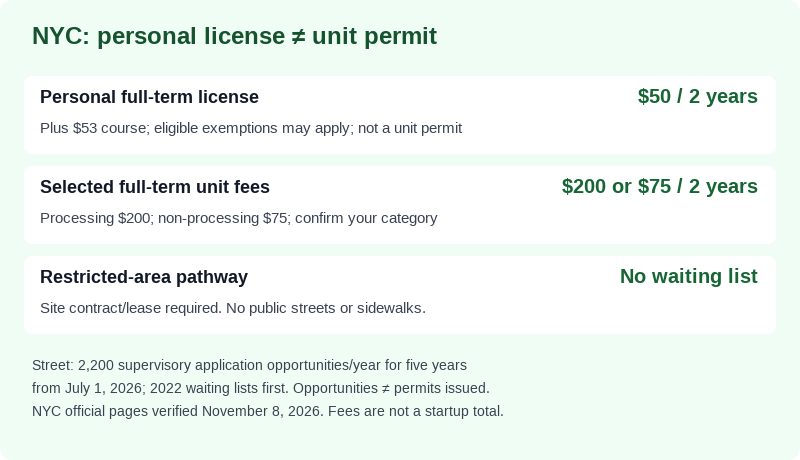
NYC separates a personal license ($50 for two years plus a $53 course) from the unit permit. Selected full-term unit categories cost $200 or $75 for two years. From July 1, 2026, supervisory application opportunities go first to the 2022 waiting lists. Restricted-area permits have no waiting list but cannot be used on public streets or sidewalks.
A NYC food truck license and a NYC food truck permit cover different things. The personal Mobile Food Vending License allows a qualified person to vend; the unit permit authorizes the particular mobile food unit under its permit conditions. Neither document gives you permission to park and sell anywhere in the city. Establish the location and permit pathway before buying a truck or signing a site agreement.
This guide covers motorized food trucks. The same distinction between a person and a unit matters when comparing a cart: lower equipment costs do not remove permit restrictions. Use the city permit comparison to compare the administrative pathways, rather than treating the lowest published fee as the cost of getting a business open.
Source check: November 8, 2026. The fees and application policy below come from the NYC pages listed in Sources. This check is separate from the article’s publication history. Confirm the category and current application instructions with DOHMH before paying a fee.
Personal license, unit permit and training
| Credential | Published fee | Term and scope |
|---|---|---|
| Personal Mobile Food Vending License, full term | $50 | Two years; person, not vehicle; eligible exemptions may apply |
| Mobile Food Vendor Food Protection Course | $53 | Separate training charge for the personal-license pathway |
| Full-term processing unit permit, selected category | $200 | Two years; unit authorization, not personal license |
| Full-term non-processing unit permit, selected category | $75 | Two years; confirm that the category fits your operation |
The personal-license page states that the ordinary personal license has no waiting list. That does not mean a street-vending unit permit is immediately available. Every person who needs the personal credential must complete the applicable process; a license held by one person is not a substitute for the credentials required of another vendor.
The full-term unit permit fee list has several entries. The $200 and $75 entries above are category-specific, not a promise that every unit permit costs one of those amounts. The list also contains a $438 two-year entry whose applicability was unclear in this verification. We have not assigned it to a permit category or added it to a budget. Ask DOHMH to identify the fee that applies to your proposed unit.
Street-vending pathway: the 2026 supervisory opportunities
According to NYC Health’s current vendor notice, beginning July 1, 2026, the city provides 2,200 supervisory license application opportunities each year for five years. These opportunities go first to people on the 2022 waiting lists. New waiting lists will be created after those lists are exhausted.
These are application opportunities, not a count of licenses or permits already issued. A new applicant should not assume immediate eligibility or approval. A supervisory license holder can apply for the corresponding unit permit, subject to the city’s process and requirements. Read the current notice for invitation, application and operating conditions before committing money to a vehicle.
This is why a description of the waiting list as simply frozen since the 1980s is no longer a useful operating plan. Access is constrained, but the current pathway includes scheduled supervisory opportunities. Keep personal-license availability separate from supervisory eligibility and unit-permit availability when speaking with the agency.
Do not pay a private seller on the assumption that a permit can automatically be transferred, rented or attached to any truck. Ask DOHMH to confirm the proposed arrangement, permit category and responsible holder. This guide supplies no secondary-market lease price: we do not have verified current evidence for one, and a private payment is not a government fee.
Restricted-area permits: no waiting list, limited locations
A Restricted Area Permit has no waiting list. It requires the relevant contract or lease with a property owner or NYC Parks, and it does not authorize vending on public streets or sidewalks. A private site must qualify; simply paying for a parking space does not establish the right to vend.
For processing units, the listed new and renewal fee is $200. For non-processing units, it is $75 for a new permit and $50 for renewal. The permit runs for no more than two years, or until the underlying contract expires if earlier. These conditions differ from the full-term street pathway, so choose the site first and verify the correct application rather than switching labels after buying a truck.
Plan the unit, commissary and legal location together
Discuss your menu, food preparation, water, wastewater, storage and servicing arrangements with DOHMH before ordering a build. The unit and its approved commissary or servicing arrangement must fit the actual operation. Ask what must take place at the commissary, what may take place on the approved unit, and what records or agreements are needed. A generic statement that all preparation must happen off the truck would not describe every approved operation.
Check the unit inspection requirements alongside the commissary agreement. A facility’s quote should identify access hours, storage, parking, cleaning, water and waste services, and any separate charges. Obtain written terms instead of assuming every commissary includes the same services. Our commissary costs guide explains questions to ask when comparing facilities.
A health permit also does not replace street, parking, fire or site approvals. Review the current rules with the relevant NYC agencies for the actual location, equipment and fuel. For private sites and events, ask who controls the site, what written permission is needed and whether the permit category authorizes that location. Avoid building a route around an unverified assumption about a particular block or public sidewalk.
Insurance evidence and contract requirements
The NYC application information calls for workers’ compensation and disability insurance evidence, or an eligible CE-200 exemption. Confirm your business’s eligibility rather than assuming a solo operation is automatically exempt. Vehicle insurance requirements must be checked separately for the vehicle and its use.
We have not verified a universal NYC food-truck statutory minimum of $2 million general liability or $1 million commercial auto. Venues, commissaries, lenders and clients can impose their own limits and additional-insured terms. Ask for those requirements in writing and distinguish per-occurrence limits from aggregate limits. Neither a venue’s contract nor a sample policy establishes the legal minimum for all operators.
Use the commercial insurance checklist to specify coverage, and the insurance cost guide for named insurer-platform examples. Those examples are not NYC quotes and should not be added together as a typical package price.
Build a quote-based startup budget
There is no verified all-in NYC startup total in this guide. Keep the confirmed government fee lines separate from quoted commercial expenses and from application availability. A small published fee does not guarantee a unit permit or a legal place to operate.
| Budget input | What to obtain before committing |
|---|---|
| Personal license and course | Applicable $50 two-year license and $53 course fees; confirm exemptions |
| Unit authorization | Written confirmation of category, availability and applicable fee |
| Truck and kitchen | Build or purchase quote matched to the proposed approved operation |
| Commissary and site | Written service scope, deposit, rent, storage and site terms |
| Insurance | Quotes with the same vehicles, drivers, limits and endorsements |
| Working capital | Your opening cash needs based on actual fixed and variable expenses |
The startup calculator provides preset planning scenarios, not a NYC permit quote. Its category amounts cannot be edited individually. Validate your actual recurring expenses in the profit calculator, and use its startup-investment input to test payback against your own assembled budget. Keep unresolved costs visible in your notes rather than filling them with an unsupported market estimate.
Frequently asked questions
How much is a NYC food vendor license?
The full-term personal Mobile Food Vending License is $50 for two years, plus the $53 food protection course, subject to applicable exemptions. It does not replace the unit permit.
How much does a NYC mobile food vending unit permit cost?
The official full-term fee list includes $200 for processing units and $75 for non-processing units, each for two years. These are category-specific fees, not a complete startup budget. Confirm your category with DOHMH; another $438 entry has unclear applicability and is not assigned here.
Is the NYC supervisory license waiting list open to new applicants?
Beginning July 1, 2026, NYC provides 2,200 supervisory license application opportunities annually for five years. Offers go first to the 2022 waiting lists; new lists follow after those are exhausted. An opportunity is not an issued license or unit permit.
Can I use a restricted-area permit on public streets?
No. Restricted-area permits have no waiting list but require a qualifying property-owner or Parks contract or lease. They do not authorize vending on public streets or sidewalks.
Does a cart avoid the NYC permit process?
No. Both carts and trucks need the applicable personal license and unit authorization. Choose the operating location and permit pathway before buying either type of unit.
Methodology & Assumptions
Cost ranges are planning models assembled from the line items and assumptions shown in this guide. They are not quotes or guaranteed market averages. This page identifies 4 cited sources; official fees and requirements should be checked against those links. AI tools may assist with organization and drafting, but they are not a source and no independent food-truck operator review is claimed. Local rules and prices can change; verify them before committing funds. Last updated: 2026-08-05.
Sources & verification
- NYC Health — Mobile and temporary food vendors Verified 2026-11-08: supervisory application opportunities, 2022 waiting lists and unit requirements.
- NYC Business — Mobile Food Vending License Verified 2026-11-08: $50 full-term personal license for two years; $53 course; exemptions may apply.
- NYC Business — Full-term unit permit Verified 2026-11-08: category-specific $200/$75 two-year fees; $438 entry applicability unresolved.
- NYC Business — Restricted Area Permit Verified 2026-11-08: no waiting list, site agreement required, no public streets or sidewalks.
Regulations and fees change. Confirm the current application, fee schedule, and operating rules with the issuing agency before purchasing a vehicle or signing a commissary agreement.